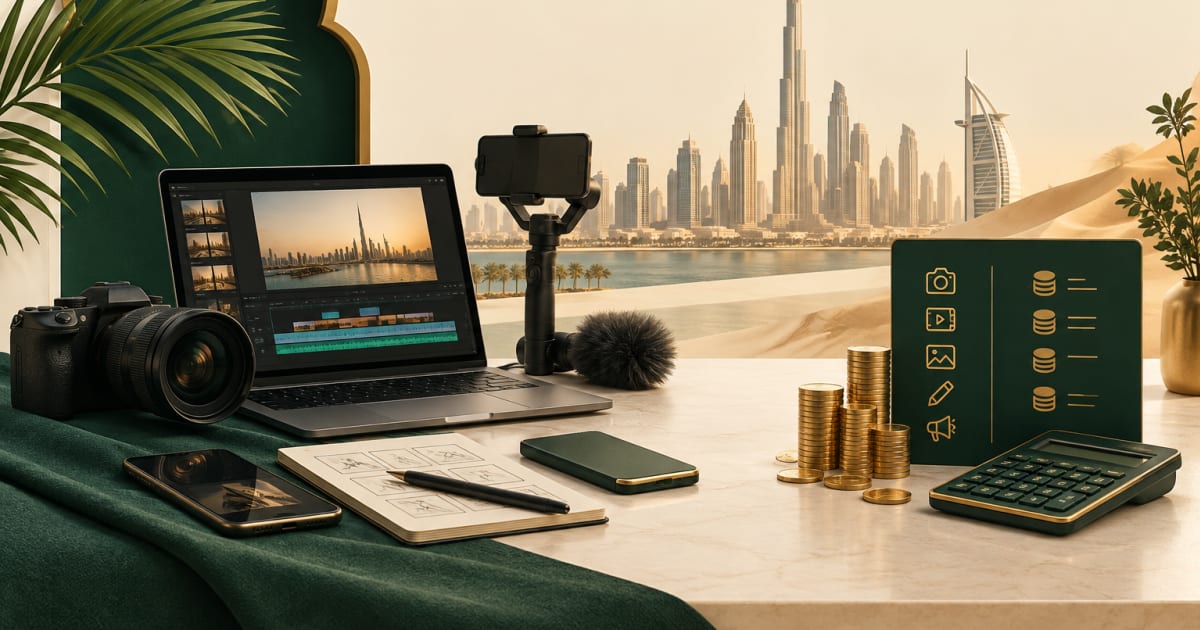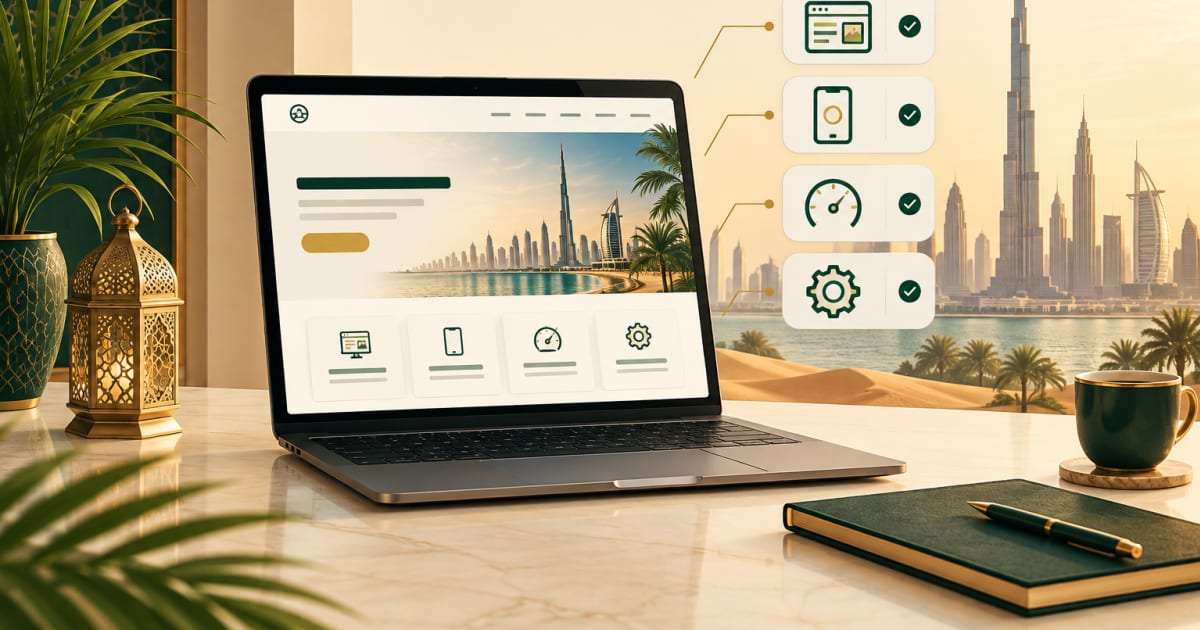

Content creation earns attention and trust before a customer ever speaks to you; a website turns that attention into an enquiry, a booking or an order. That is what content creation can do for sales in the UAE, and it is why the two have to be planned together: a reel with no page to land on wastes the view, and a website with no fresh content has nobody arriving at it.
In this article
- What content creation can do in the feed, in ads, on Google and in WhatsApp
- In the feed: proof that you are open, real and current
- In ads: the creative that decides the cost per enquiry
- On Google: the page that answers the question
- In WhatsApp replies: the asset that closes
- What a website does that Instagram cannot
- The Instagram-only trap
- Which content and which website does your business need at each stage?
- How to read the table
- A 60-day plan to get content and the website working together
- Days 1 to 10: decide the offer and the page
- Days 11 to 20: shoot once, for everything
- Days 21 to 35: publish and connect
- Days 36 to 50: run a small test
- Days 51 to 60: review and set the monthly rhythm
- The one next step
- Content has four jobs: the feed, the ads, the Google result and the WhatsApp reply. Brief every shoot for all four.
- A website does five things Instagram cannot: it is found on Google, shows prices, takes bookings, holds the WhatsApp button and keeps your data.
- Most UAE service businesses need 4 to 6 reels and 8 to 12 posts a month to stay visible; a well-briefed half-day shoot typically produces 15 or more edited assets.
- An Instagram-only business pays twice: once in ads that have nowhere to send people, and again in enquiries that stall in the DMs.
- Sixty days is enough to launch a one-page site, run one shoot and connect the two with a WhatsApp flow.
This guide is for owners of clinics, restaurants, shops and service firms in the UAE who post regularly but are not sure the posting sells anything, and for those who have a website nobody visits. I write it from the production side: what we see through the camera on a shoot day, and what the client sees in the enquiry inbox a month later.
What content creation can do in the feed, in ads, on Google and in WhatsApp
Content is not decoration. Each photo, reel and caption is a working asset with a specific job, and the job depends on where it appears.
In the feed: proof that you are open, real and current
A customer who finds a perfume brand in Al Majaz on Instagram looks at the last three posts before anything else. Dated posts, stock images or an empty grid read as a closed shop. A feed with the product in hand, the team at work and this week's offer reads as a business that will answer the phone.
In ads: the creative that decides the cost per enquiry
On Meta, TikTok and Snapchat, the same budget buys very different results depending on the video. In our experience, a reel shot on location with a real person and a clear first second typically outperforms a designed graphic by a wide margin. Ads do not fix weak content; they amplify whatever you give them. We cover the formats that hold attention in reels and UGC that sell.
On Google: the page that answers the question
Text is content too. A page that explains your service, prices and process in plain Arabic and English is what Google ranks and what AI answer engines quote. Google's own guidance on helpful, people-first content is a good test: would a customer find this page useful if they arrived from a search? Photos and short videos embedded on that page do double duty, because they are the same assets you shot for Instagram.
In WhatsApp replies: the asset that closes
The most underrated place for content is the reply to "how much?" on WhatsApp. A menu image, a 20-second treatment explainer, a before-and-after of a kitchen renovation or a price list PDF sent within minutes keeps the conversation alive. Businesses that keep a library of these replies answer faster and lose fewer enquiries to the next tab.
What a website does that Instagram cannot
Instagram is rented space. A website is owned space. The difference shows up in five concrete ways.

| Job | Instagram alone | A website |
|---|---|---|
| Being found on Google and Maps | Rarely; profiles seldom rank for service searches | Yes; service pages, FAQ and location pages rank for "near me" and Arabic queries |
| Showing prices and packages | Buried in highlights or answered one by one in DMs | A clear pricing or packages page, open 24 hours |
| Taking a booking or an order | A link in bio to a third-party tool, or a DM | A form, a calendar or an order flow on your own domain |
| The WhatsApp button | One link, no context | A button on every page, pre-filled with the service the visitor was reading |
| Owning the data | The platform owns the audience and the analytics | You own the visitor data, the pixel, the enquiry history and the email list |
Two of these matter more than the others for sales. Being found on Google means enquiries that arrive without ad spend, from people who were already searching. The WhatsApp button with context means the first message says "I am asking about the three-bedroom deep clean" rather than "hi". WhatsApp's click-to-chat links can carry a pre-filled message, as its help centre explains, and a website is the natural place to put one on every service page.
A website also protects you from the platform. An account restriction, a hacked login or a change in the algorithm can switch off an Instagram-only business overnight. We go into what a site should contain and what it costs in the UAE in website design in the UAE: how it works and what it costs.
The Instagram-only trap
Many UAE businesses start on Instagram because it is free and visual, and that is the right start. The trap is staying there once the business is real.
The pattern is familiar. A salon in Al Nahda runs an ad to its Instagram profile. The viewer taps, scrolls, sends a DM, and the enquiry sits for three hours because the receptionist is with a client. By evening the customer has booked elsewhere. The ad worked; the funnel did not. The same salon with a one-page site and a booking form would have captured the slot while nobody was looking at the phone.
The second cost is invisible. Every enquiry answered in DMs leaves no record you control: no source, no stage, no follow-up list. When you finally build a site and a simple customer list, you start from zero.
The third cost is Google. People search "laser clinic Sharjah" and "مطعم مشاوي الشارقة" every day. Without a website you are absent from most of those results, however good the grid looks.
None of this means posting less. It means giving the posts somewhere to send people. A single landing page with a clear offer and a form is often enough to start; we show the structure in landing pages that convert.
Which content and which website does your business need at each stage?
The answer depends on where the business is, not on what competitors post. The table uses Silk Road's published entry points; custom websites are quoted per project after a short call, because a one-page site and a bilingual e-commerce build are not the same job.
| Stage | Content you need | Website you need | Silk Road entry point |
|---|---|---|---|
| Opening soon or just opened | One shoot: the space, the team, 10 to 15 hero products or services | One page: what, where, prices, WhatsApp button, map | Content Day, AED 2,500 one-off; a one-page site quoted per project |
| Trading, posting from a phone, enquiries arriving in DMs | 4 reels, 8 posts and 20 stories a month, planned around offers | A 5 to 8 page site: services, prices, about, FAQ, contact, in Arabic and English | Presence social media package, AED 5,500 a month, plus a site quoted per project |
| Running ads with a monthly budget of AED 3,000 or more | 6 reels and 12 posts a month with a monthly shoot, so the ads never reuse stale video | A landing page per campaign, a pixel, a booking or order flow | Growth social media package, AED 6,900 a month, with landing pages quoted per project |
| Several branches or a product catalogue | A content system: templates, shot lists, a quarterly campaign calendar | A full site with locations, a catalogue, bookings and tracking | Scoped as one project across web design and content creation |
A note on the website column. In the UAE market, a bilingual brochure site for a small business is typically quoted anywhere from about AED 6,000 to 25,000 depending on pages, design and integrations, and e-commerce builds run higher.
How to read the table
Content and the website scale together. The business posting from a phone with no site does not need more content; it needs a page to send people to. The business spending on ads does not need a bigger site; it needs fresh video every month so the ads stop decaying. Buy the missing half first.
A 60-day plan to get content and the website working together
Sixty days is a realistic window for a small UAE business to go from "Instagram only" to a working system. The sequence matters more than the budget.
Days 1 to 10: decide the offer and the page
Pick the one service or product that makes you the most money per enquiry. Write its page in Arabic and English: what it is, who it is for, the price or price range, the three questions customers always ask, and the WhatsApp button with a pre-filled message. If you have no site, this is the whole site for now. Register the domain in the business name, not in an employee's.
Days 11 to 20: shoot once, for everything
Book one shoot day and brief it for all four jobs: hero photos for the page, 8 to 12 short vertical clips for reels and ads, product or treatment close-ups for WhatsApp replies, and team portraits for the about section. A half-day shoot planned this way typically yields 15 or more edited assets.
Days 21 to 35: publish and connect
Put the page live with the new photos. Post the first reels with the page link in the bio and in stories. Set the WhatsApp Business greeting and quick replies so that an enquiry from the page gets an answer in minutes, with the image or the PDF ready to send. Install the Meta pixel on the page even if you are not advertising yet; the data starts collecting from day one.
Days 36 to 50: run a small test
Spend a modest amount, typically AED 1,500 to 3,000 for a first test in the UAE, on one reel that drives to the page, not to the profile. Measure the cost per WhatsApp conversation or form submission.
Days 51 to 60: review and set the monthly rhythm
Look at three numbers: visitors to the page, enquiries started, bookings made. Decide the monthly content count from what the ads consumed, and write the next shoot brief from what customers asked on WhatsApp. From here, content and the website feed each other: every question becomes a post and an FAQ entry, and every new product becomes a reel and a page section.
If you would rather hand the production and the page to one team, Silk Road's content creation and web design services are built to run as a pair, and the packages page lists what each month includes.
The one next step
If you take one action from this article, make it this: give your content a destination you own. Write the single page for your most profitable service, put the WhatsApp button on it, and point the next reel at it. Everything else, the shoot, the monthly plan, the ads, works better once that page exists. If you want a second pair of eyes on the page or on the shoot brief, send it over and we will tell you what we would change.
Frequently asked questions
Comments
- #content-creation
- #website
- #sales
- #uae
- #صناعة المحتوى
- #موقع إلكتروني
- #إنستغرام
- #مبيعات
- #الإمارات