Influencer Marketing Agency Dubai: How to Choose One in 2026
What an influencer marketing agency Dubai does, how fees work, hedged AED ranges, and a comparison table to help you decide.
By , Co-founder, Architecture Engineer··9 min read
Frequently asked questions
Platforms change format, but the underlying idea, a trusted person recommending a product to their audience, has outlasted several algorithm shifts already. Short-form video and creator-led content keep gaining ad budget share on Meta and TikTok, so the format is more likely to evolve than disappear. The honest risk is not the channel dying, it is brands running one-off posts with no strategy and concluding wrongly that "influencer marketing doesn't work".
A small business rarely has the production budget for cinematic ads, but a well-matched creator already has an audience, a trusted voice and a camera. For a dental clinic in Al Nahda or a perfume brand in Al Majaz, one credible creator review can do more for local trust than weeks of brand-only posting. It is also one of the few channels where a modest, hedged test budget can show results within a single campaign cycle.
It is a written plan covering who you are targeting, which creator tiers fit that audience, what the content must say, how many posts or reels happen and over what period, and how you will judge success, usually reach, saves, clicks or bookings. Without that plan, influencer spend becomes a series of disconnected posts instead of a campaign. A strategy also has to include brand safety rules and UAE advertising compliance from day one.
Yes. The UAE's National Media Office requires individuals who post paid or sponsored content as a profession to hold a social media influencer licence. A serious influencer marketing agency in Dubai will only work with licensed creators and will ask for proof before a contract is signed, which protects the brand as well as the creator.
Agency management fees and creator fees are usually quoted separately, and neither follows a fixed published rate card in this market. In our experience, creator fees typically scale with follower count and content format, with a nano creator's story usually costing noticeably less than a macro creator's dedicated reel, but the gap varies too much by niche, season and negotiation to state as a single AED range. Always ask for a line-by-line quote covering agency fee, creator fee and any ad spend separately.
An influencer marketing agency Dubai brands hire is a team that finds the right creators, negotiates and contracts them, briefs the content, and reports on results, so the business does not have to manage dozens of individual creator relationships itself. The agency sits between the brand and the creator, handling licensing checks, content approval and payment, while the brand keeps control of the message.
An influencer marketing agency in Dubai manages sourcing, contracts, briefing and reporting, not just introductions.
UAE creators posting sponsored content are required to hold a National Media Office influencer licence; agencies should verify this before signing.
Creator fees and agency management fees are usually quoted separately, and both vary a great deal by tier and scope, so ask for a line-by-line quote.
A written influencer marketing strategy, audience, tier, deliverables, timeline, and a measurement method, is what separates a campaign from a series of random posts.
Nano and micro creators typically suit local, trust-driven categories like clinics and cafés; macro and celebrity creators suit reach-driven launches.
This guide is for a UAE business owner, marketing manager or franchise operator deciding whether to run influencer campaigns through an agency, a freelancer, or in-house. It covers what the agency model actually does, why the format works when it works, how UAE licensing applies, and what a realistic strategy and budget conversation looks like.
What does an influencer marketing agency in Dubai actually do?
The core job is matching and managing, not just "finding influencers". A competent agency will:
Shortlist creators by audience fit, not follower count alone.
Check each creator's National Media Office licence status.
Negotiate fees, usage rights and exclusivity windows.
Write or approve the creative brief so the content still sounds like the creator, not a script.
Track delivery against the agreed content calendar.
Report on reach, engagement, saves and, where tracked, clicks or bookings.
Many UAE agencies, including the content and social teams behind packages like Presence, Growth and Impact, also combine influencer work with paid media, so a creator's reel can be boosted as a Meta or TikTok ad rather than relying on organic reach alone. That pairing is one reason agencies tend to outperform one-off creator deals: the content gets a second life as an ad.
What is influencer marketing and how does it work?
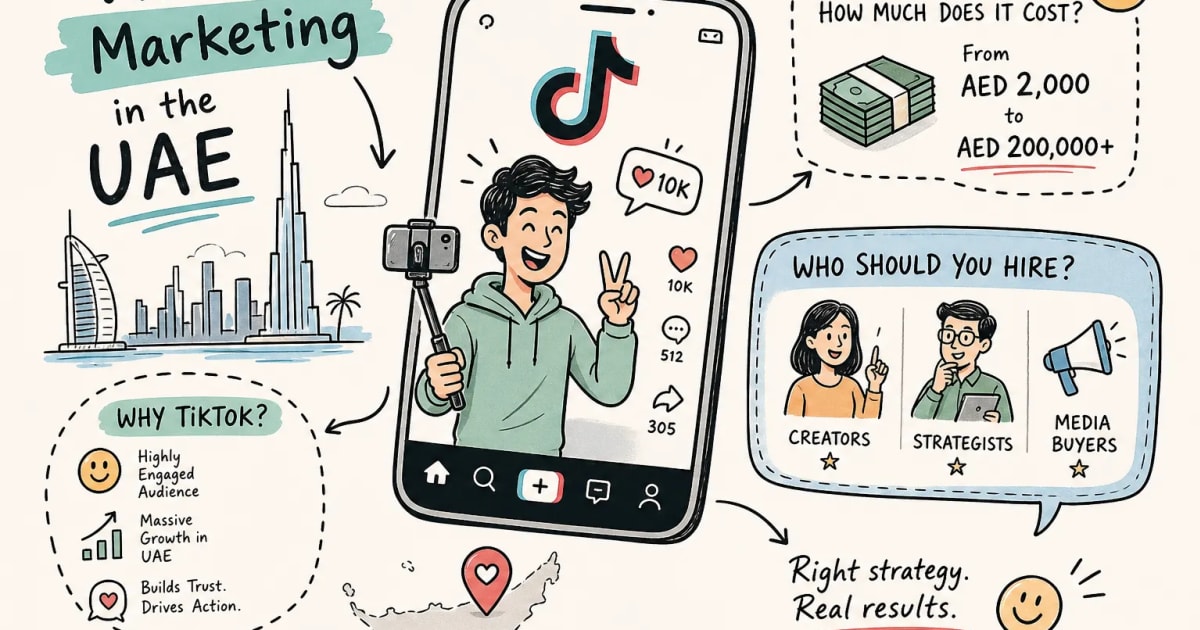
Influencer marketing is paying or gifting a creator with an existing, trusted audience to feature your product or service in their own content style. It works on a simple chain: the creator's audience already pays attention to them, the creator's endorsement transfers some of that trust to the brand, and the audience acts, visits, follows, buys, because the recommendation came from someone they chose to follow rather than an ad they scrolled past.
D. Lubna Al Aidaroos - work by Silk Road Digital Solutions
The mechanics in a typical UAE campaign:
Brief: the brand shares goals, key messages and no-go topics.
Creator selection: nano, micro, macro or celebrity tier, chosen by audience match.
Content: usually a reel, story set or TikTok, sometimes a long-form review.
Usage rights: whether the brand can repost or run the content as a paid ad.
Reporting: screenshots or platform analytics shared after posting.
Why does influencer marketing work, and why is it effective?
Three mechanics explain most of the effect:
Borrowed trust. A follower trusts the creator's taste before they trust the brand's ad copy. That trust transfers, imperfectly but measurably, to whatever the creator is showing.
Native format. A reel shot in the creator's own style blends into the feed instead of interrupting it. Meta's own guidance on branded content notes that disclosed partnerships still perform within normal organic placements, not as a separate ad unit, which is part of why they read as less interruptive.
Social proof at scale. One creator post reaching a few thousand relevant local followers can produce more qualified attention for a neighbourhood business, a workshop in Al Quoz or a clinic in Al Nahda, than a broad, untargeted ad to the same budget, because the audience is already self-selected around that creator's niche.
Why is influencer marketing important for UAE brands specifically?
The UAE has an unusually high density of engaged social media users and a culture of asking friends and creators for recommendations before buying, especially in food, beauty, real estate and healthcare. That makes word-of-mouth-style marketing disproportionately valuable here compared with markets where people rely more on search or classified ads first. It is also one of the few formats that works in both Arabic and English content without feeling translated, since creators naturally code-switch the way their actual audience does.
D. Lubna Al Aidaroos - work by Silk Road Digital Solutions
Will influencer marketing last?
The format is maturing, not disappearing. Instagram, TikTok and Snapchat have all built dedicated tools for branded content disclosure and creator partnerships, which is a sign platforms expect the category to keep growing rather than fade. What is changing is scrutiny: audiences are quicker to spot a disconnected, script-read post, and regulators are formalising licensing. Brands that treat influencer marketing as a one-off stunt will likely see declining results; brands that treat it as an ongoing relationship with a smaller number of well-matched creators tend to see it hold up over multiple campaign cycles.
Which brands use influencer marketing, and how?
Almost every consumer category in the UAE now runs some form of creator partnership, but the approach differs by sector.
Sector
Typical creator tier used
Typical content format
What it is trying to achieve
Restaurants and cafés
Nano to micro, local food creators
Reel, story takeover
Foot traffic, menu awareness
Clinics and personal brands
Micro, patient-adjacent creators, compliant copy only
Reel, review-style post
Trust, appointment enquiries
Real estate
Micro to macro
Property walk-through reel
Lead generation, listing reach
Fashion and beauty
Micro to macro, sometimes celebrity
Try-on reel, unboxing
Awareness, launch buzz
B2B and services
Rarely creator-led, more LinkedIn or Google Ads
Case study, testimonial
Credibility, not reach
Large international brands typically layer macro or celebrity creators on top of a wider paid campaign; small and mid-size UAE businesses usually get more cost-efficient results from a handful of local nano and micro creators whose followers are genuinely nearby.
What should an influencer marketing strategy actually include?
A document, not a spreadsheet of names. At minimum it should set out:
Audience and goal
Who the campaign is trying to reach, and what action counts as success, a booking, a follow, a store visit.
Creator tier and number
In our experience, most UAE campaigns for a local business work better with several nano or micro creators than one macro creator, since the combined reach is similarly local but the cost per authentic post is usually lower, though exact fees always need a direct quote.
Deliverables and timeline
Exactly what each creator posts, in what format, over what period, with a clear approval step before anything goes live.
Compliance
For clinics this means staying inside Ministry of Health and Prevention and Emirates Health Services advertising rules, or DHA and Department of Health Abu Dhabi rules in those emirates; our clinic social media management guide covers this in more detail.
Measurement
Reach and engagement are easy to pull from the platform; clicks, bookings or promo code redemptions need to be set up before the campaign starts, not after.
Comparing the three ways to run influencer marketing in the UAE
Option
Best for
Typical trade-off
Agency-managed
Businesses wanting vetted, licensed creators and reporting without managing it themselves
Agency fee on top of creator fees, but less risk and admin
Freelance consultant
Businesses with a clear plan who just need sourcing help
Usually cheaper than a full agency, but less brand-safety checking
In-house / DIY
Businesses with an existing social following and time to negotiate directly
No management fee, but higher risk of unlicensed creators or weak content
Our broader comparison of agency vs freelancer in Dubai applies directly to this decision, since the trade-offs are nearly identical.
How do agency fees and creator fees actually work?
The two are separate line items, and a transparent agency will never blend them into one unexplained number.
Agency management fee: covers sourcing, contracting, licence checks, briefing and reporting. Scope and scale vary enough between businesses that a fixed figure would be misleading; ask for a quote against your specific creator count and campaign length.
Creator fee: paid to the creator, often tiered by follower count and format. Market rates in the UAE swing a great deal between a nano creator's story and a macro creator's dedicated reel, so treat any number you hear as a starting point for negotiation, not a fixed price.
Ad spend, if content is boosted: paid directly to the platform. Silk Road's own media buying model, for comparison, charges management as 30% of the monthly ad budget with a minimum of AED 900 per platform per month, full detail on the media buying page, which gives a sense of how ad management fees are typically structured even when the creator fee itself sits outside that model.
If the goal is ongoing content plus paid promotion rather than one-off influencer posts, a monthly package can be more predictable: see the social media packages starting from Presence at AED 5,500 per month, which bundle content creation with reporting.
Where to find and vet UAE creators
Two practical routes exist for a UAE business right now:
Through an agency's existing creator network, which should have already checked licensing and past brand safety.
Directly, using a vetted marketplace. Silk Road runs a creator community where UAE brands can hire vetted content creators, and creators themselves can apply to join at creators.
Before choosing an agency, freelancer or in-house route, write down what a successful campaign looks like in numbers you can actually measure, bookings, follows, or promo code redemptions, not just views. That single step determines which creator tier, which content format and which reporting method actually make sense for the budget. For a working example of how this fits into a wider content and paid media plan, our portfolio shows recent creator and campaign work, and the team can map out a plan on a short call.