Marketing automation UAE businesses can use today does three jobs: it answers every enquiry within seconds, it follows up with the people who went quiet, and it reminds customers to come back. A CRM is the list that makes it possible, one record for every lead with its source, its stage and its next action. Together they close the most common leak in UAE small businesses: enquiries that are answered late or never. This guide explains both in plain terms, with a manual-week versus automated-week comparison for a clinic, a restaurant and a real estate office.
In this article
- The leak most UAE SMEs have
- Marketing automation UAE: what it does in plain terms
- What a CRM does
- A manual week versus an automated week
- WhatsApp Business tools and the 24-hour window
- Email and SMS: consent and unsubscribe
- What to automate first: free, then with a CRM
- Free, this week, inside the WhatsApp Business app
- Next, with a simple CRM
- What not to automate
- The next step: measure your reply time for one week
- The biggest leak in most UAE SMEs is not weak marketing but enquiries answered late or never; automation plugs it before you spend more on ads.
- Automation does five things: instant replies, follow-ups, reminders, review requests and re-engagement after a week of silence.
- A CRM is one list of every lead with source, stage and next action; without it, automation has nothing to act on.
- WhatsApp gives you a 24-hour window after a customer's message; outside it, only approved template messages can be sent.
- Start free with the WhatsApp Business app's greetings and quick replies, then add a CRM; never automate complaints or price negotiations.
This article belongs to our series on what each marketing service actually does. It is for the owner who already gets enquiries, from Instagram, Google or a referral, and suspects that too many of them disappear between the first message and the sale. If you are still working on getting enquiries at all, start with our guide to turning WhatsApp enquiries into bookings and come back here.
The leak most UAE SMEs have
Walk into most small businesses in Sharjah, Dubai or Abu Dhabi and the pattern is the same. The WhatsApp number is on a staff phone. Messages arrive at 9 pm, during a procedure, while the shop is full. The first reply comes the next morning, or not at all. The customer who asked for a price and said "I will think about it" is never contacted again. The patient who booked is not reminded, and 10 to 20% of appointments quietly go missing. Nobody asks the happy customer for a review.
None of this is a marketing problem in the usual sense. The ads worked; the content worked; the enquiry arrived. The leak is in what happens next, and it is the cheapest problem in the business to fix, because the customer has already raised a hand.
Before you spend another dirham on reach, count three things for one week: how many enquiries arrived, how many received a reply within 15 minutes, and how many were followed up after the first reply. In our experience the second and third numbers are the ones that shock owners.
Marketing automation UAE: what it does in plain terms
Automation means a message or a task happens because of a rule, not because someone remembered. For a small business it does five concrete things.
- Instant replies. A customer messages at any hour and receives, within seconds, a greeting in their language that says you have received it, when a person will reply and what you need from them (name, service, preferred time). No sale happens here, but the customer stops looking elsewhere.
- Follow-ups. The person who received a quote and went quiet gets one polite message two or three days later and one more a week after that. Most owners never send these; most sales that recover come from them.
- Reminders. A message the day before an appointment, a delivery or a viewing, with a one-tap confirm or reschedule option. This is the single highest-value automation for clinics, salons and service companies.
- Review requests. A message a few hours after the visit or delivery with a direct link to your Google review page, sent only to customers whose job was completed.
- Re-engagement. A message to customers who have not visited in a set period, typically 30 to 90 days depending on the business, with a reason to return: a new service, a seasonal offer, a reminder that a check-up is due.
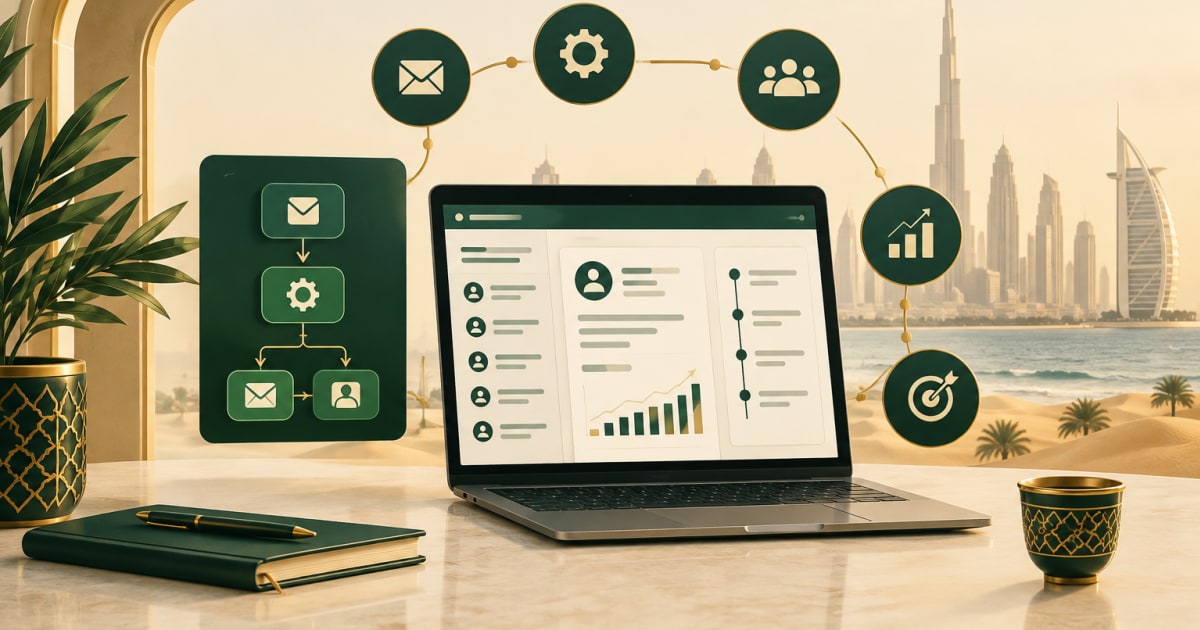
Each of these is a rule: when X happens, after Y time, send Z. Writing the rules is the work; the tools then run them every day without fail.
What a CRM does
A CRM (customer relationship management system) sounds like something for a bank. For a small UAE business it is one list, with one row per lead, and five columns that matter:
- Source: where the enquiry came from (Instagram, Google, a referral, a walk-in, an ad).
- Stage: new, replied, quoted, booked, completed, lost.
- Next action and date: what should happen next and when.
- Owner: which team member is responsible.
- Notes: the service asked about, the price quoted, the objection raised.
That list does three things a WhatsApp chat cannot. It shows you every lead that has no next action, which is every lead you are about to lose. It tells you which source produces customers rather than just messages, which is the number you need to decide next quarter's budget, as explained in how to measure the return on digital marketing. And it gives the automation something to act on: a reminder cannot send itself if nobody recorded the appointment.
A spreadsheet is a CRM for the first few months. You outgrow it when two people need the same list at the same time, or when you want follow-ups to send themselves.
A manual week versus an automated week
The table compares a typical week before and after basic automation for three common UAE businesses. The figures are illustrative ranges from our experience, not measured results.
| Business | The manual week | The automated week |
|---|---|---|
| Dental clinic in Al Nahda, 30 to 40 enquiries a week | Reception replies between patients; evening messages wait until morning; no reminders; roughly 1 in 6 appointments missed; reviews requested only when someone remembers | Instant acknowledgement in Arabic or English; reminder 24 hours before with confirm or reschedule; missed appointments typically fall by a third or more; review link sent after each completed visit |
| Restaurant in Al Majaz with delivery and catering | Catering requests answered by the manager when free, sometimes a day later; no follow-up on quotes; regulars never contacted | Catering enquiries receive the menu and a deposit request within seconds; a follow-up on every quote after three days; a monthly message to past catering customers before Eid, National Day and Ramadan |
| Real estate office in Dubai, 50 or more portal and ad leads a week | Leads arrive by email, portal and WhatsApp and are copied into a notebook; agents follow up when they can; most leads receive one call and are forgotten | Every lead lands in one pipeline with its source; an instant message asks for budget and area; viewings are confirmed automatically; unanswered leads are re-contacted after three and seven days; the manager sees which portal actually produces viewings |
In each case the manual week is not lazy; it is what happens when the same people serve customers and answer messages. Automation removes the dependence on memory and on quiet moments.
WhatsApp Business tools and the 24-hour window
Most automation for UAE businesses runs on WhatsApp, because that is where customers already are. Two tools exist, and they are often confused.
The WhatsApp Business app is free, runs on one phone (with a few linked devices) and offers a business profile, a greeting message, an away message, quick replies, labels and a catalogue. This is where every small business should start.
The WhatsApp Business Platform (the API) is for businesses that need multiple agents, a CRM integration or automated sequences at scale. It is accessed through a provider and costs money per conversation. Meta's documentation on WhatsApp Business Platform pricing and the customer service window explains the key rule: after a customer messages you, you have a 24-hour window in which you can reply freely. Outside that window you can only send template messages that Meta has approved in advance, such as appointment reminders or order updates, and the customer must have opted in to receive them.
Two practical consequences: reply fast, because the window is your freest and cheapest moment with the customer; and write your reminders and follow-ups as templates from the start, so they can be sent legally after the window closes. Check the current Meta pricing and policy pages before building anything, because the rules and conversation categories change.
Email and SMS: consent and unsubscribe
WhatsApp dominates, but email and SMS still have a place for receipts, appointment confirmations and the occasional seasonal campaign. The rules are simple and worth following strictly:
- Consent first. Collect the email or mobile number with a clear statement of what you will send. A customer who booked once has not agreed to a weekly newsletter.
- An unsubscribe path in every message. For email, a link; for SMS, a reply keyword. Honour it immediately.
- Sender identity. Use a registered sender name and your real business details; the UAE's telecom regulator and the operators act against spam from unregistered senders, and your campaigns will be filtered.
- Timing. No promotional messages late at night, and be careful with timing during Ramadan and public holidays.
If a tool makes it hard to prove consent or to unsubscribe, do not use it for marketing in the UAE.
What to automate first: free, then with a CRM
Free, this week, inside the WhatsApp Business app
- A greeting message in Arabic and English for first-time contacts, with your hours and what you need from them.
- An away message for outside hours that gives an honest reply time.
- Quick replies for your five most common questions: price, location, hours, booking, delivery.
- Labels for new, quoted, booked and completed, so you can see at a glance who needs a follow-up.
- A catalogue if you sell products, so you stop sending the same photos by hand.
Next, with a simple CRM
- One pipeline with the stages above and a next action on every lead.
- Appointment or delivery reminders 24 hours before, as approved templates.
- Quote follow-ups at three and seven days.
- Review requests after completion.
- Re-engagement at 30, 60 or 90 days with a genuine reason to return.
Silk Road sets up these CRM journeys for clients as part of its packages when follow-up is the bottleneck, alongside the content and ads that bring the enquiries in. Whether you do it yourself or with help, build the rules in that order; each one depends on the one before.
What not to automate
Automation is for the predictable. Hand these to a person every time:
- Complaints. An automated reply to an angry message makes it worse. Route anything with a complaint keyword straight to the owner or manager.
- Price negotiations. Gulf customers expect a conversation; a bot that repeats the list price loses the sale and the goodwill.
- Medical, legal and financial questions. Automation can acknowledge and book; a qualified person answers.
- Anything after the second automated message. If the customer has replied twice and the question is still open, a human takes over. Two automated messages in a row without a human is where "cold" begins.
The test is simple: automate the message you would be happy to send word for word to a thousand customers; keep everything else personal.
The next step: measure your reply time for one week
Before buying any tool, measure three numbers for seven days: enquiries received, enquiries answered within 15 minutes and enquiries followed up after the first reply. Then set up the free WhatsApp Business greetings and quick replies, and measure again. Most owners see the gap close before they have spent a dirham.
If you would like help building the pipeline and the sequences around your existing content and ads, Silk Road Digital Solutions sets them up inside its packages; get in touch and tell us what happens to an enquiry in your business today.
Frequently asked questions
Comments
- #marketing-automation
- #crm
- #whatsapp-business
- #lead-follow-up
- #uae
- #أتمتة التسويق
- #إدارة علاقات العملاء
- #واتساب للأعمال
- #متابعة العملاء
- #الإمارات